
Tidio bundles live chat, ticketing, flow automation and its Lyro AI agent, metered by conversation. Answer HQ is the alternative when you don't want to build and maintain chat flows: it answers from your own website and documents, cites the source of every answer, and costs a flat $199 or $299 a month. Tidio is cheaper at very low volume.
The distinction that matters isn't live chat versus AI. It's where the answers come from. A flow builder asks you to anticipate the question, draw the branch and write the reply, then do it again when your returns policy changes. Answer HQ reads your content and answers from it, so updating a help article is how you change what the assistant says. Tidio's own pricing, checked August 29, 2026, meters two things at once: billable conversations for your team, and Lyro AI conversations. Starter is $24.17 a month with 100 billable conversations and a one-off 50 Lyro conversations, Growth starts at $49.17 from 250 conversations, and Plus starts at $300 a month plus usage. Answer HQ charges a flat rate for 1,000 or 5,000 AI answers with no per-seat fee.
What a flow builder costs you after month one
Building the first ten flows is fun. The maintenance is the part nobody budgets for.
Every policy change means finding the flows that mention it. Every new product means new branches. Every question you didn't anticipate falls through to a human or, worse, to a dead-end menu. I've watched small teams end up with 40 flows nobody dares touch, so they stop touching them, and the bot slowly goes stale while support volume climbs back.
Content-based answering has the opposite maintenance shape. There's one place to fix: the page or article the answer came from. Because Answer HQ attaches Quick Citations to every reply, a wrong answer tells you exactly which page is wrong.
Does Answer HQ do live chat?
No, and this is the honest dividing line. There's no live chat with human agents inside Answer HQ, no agent console, no queue, no routing rules, no CSAT survey product. If a customer needs a person, they use a contact form inside the conversation and it lands in Tickets, which threads over email. Tickets is on every plan.
Tidio does have real live chat with a visitor list, typing previews and chat assignment. If watching visitors on your site and jumping into conversations is central to how you sell, that's a reason to stay.
How the two handle proactive selling
Tidio's Flows can reach visitors proactively, and it prices that separately as visitors reached. It's a marketing surface as much as a support one.
Answer HQ doesn't do proactive outreach. It sits behind the Orb until a customer opens it. You can shape what happens next: Quick Questions are preset prompts you can drag to reorder, and Pro and Growth get custom widget themes so it looks like part of your site rather than a bolt-on. That's the extent of it, and for a support-first team that's usually the right amount.
Which one answers harder questions better?
I can't tell you whose model is smarter, and I'm not going to make a claim about Lyro's accuracy that I can't back up. What I can tell you is what Answer HQ does mechanically, because that's the part you can verify in a trial.
Retrieval runs in two stages, vector search then a reranker, over a private Knowledge Vault built from your crawled website and uploaded files. Answers are multilingual: ZURIGA is served in German, and their team ran their own accuracy test against four competing tools and found Answer HQ significantly more accurate on four of five questions. That's their test, on their content, which is the only kind of accuracy result worth anything. Run the same test yourself during a trial with your fifteen most common questions.
Page limits are the thing to check before you commit: 100 knowledge pages on Basic, 500 on Pro, 1,500 on Growth, with re-imports monthly, weekly or every three days depending on plan. Full detail is on the pricing page.
What you get that a chatbot builder doesn't
Two things, both of which come from answers being grounded in content.
The first is a help center you didn't have to build twice. Articles in Answer HQ are unlimited, hosted as a public help center, and the same articles appear in the Help tab of the chat widget with categories and search. Three visibilities: published, Assistant only for content that should inform answers but never be cited or public, and draft. There's a one-click Markdown export if you ever want out.
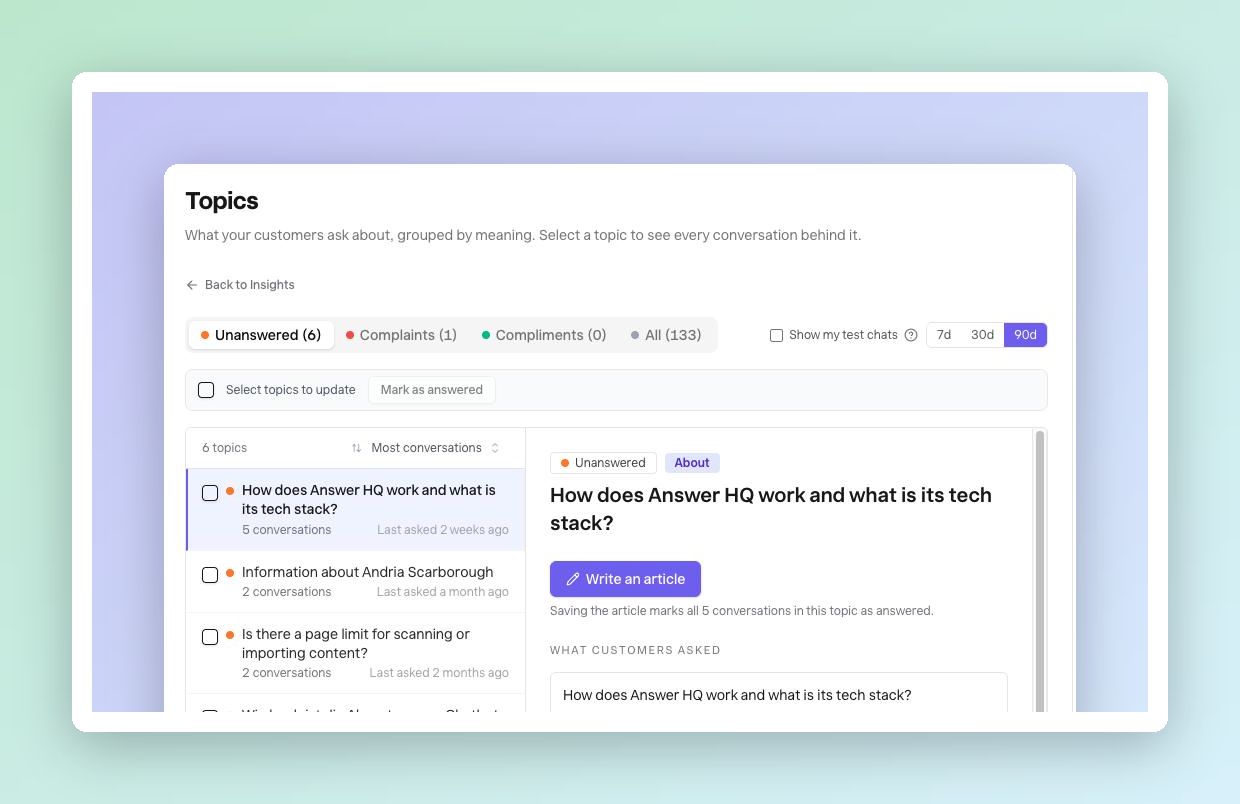
The second is knowledge gap analysis. On Pro and Growth, Insights groups questions into Topics by meaning rather than keywords, then ranks the gaps where customers asked something your content doesn't answer, with a guided flow that pre-fills an article from those real questions. Chats get analyzed on every plan, so historical data lights up the moment you upgrade. That's the loop I care about: customers ask, you find out what's missing, the content gets better, fewer questions reach you.
Choose Tidio if
- Live chat with human agents is the point, not a fallback.
- You want proactive chat campaigns to visitors before they ask anything.
- Your volume is genuinely tiny and $24 a month beats a flat $199.
- You need departments, seat management or ticketing automations inside one tool.
Choose Answer HQ if
- You don't want to build or maintain conversation flows.
- You want every answer traceable to a page you control.
- A predictable flat bill matters more than a low entry price.
- You want the tool to tell you which help content is missing.
FAQ
Is Tidio or Answer HQ cheaper?
Depends entirely on volume. Tidio starts at $24.17 a month for 100 billable conversations as of August 29, 2026, so at very low volume it's cheaper. Both its billable conversations and Lyro AI conversations are metered, so cost rises with use, while Answer HQ stays at $199 for 1,000 AI answers or $299 for 5,000 with no per-agent charge. Yearly billing on Answer HQ gives you two months free.
Can I use Answer HQ without replacing my current chat tool?
Yes. The widget is one script tag, or a theme app embed if you install the Shopify app, and it answers questions independently of whatever else you run. Plenty of stores keep their existing chat for sales conversations.
Do I have to write help articles before it works?
No. Import your website and it answers from those pages immediately. Articles are how you fix and extend answers over time, and Insights tells you which ones to write first. I explained that flow in Introducing Insights.
Does Answer HQ support WhatsApp or Instagram?
No. There's no WhatsApp, SMS, Instagram, Facebook or social channel, and no phone or voice support. The widget on your site plus email handoff through Tickets is the whole channel list. Tidio covers more channels, so if that's a requirement it's a real reason to pick them.
How long does setup take?
Minutes, not days. Import your site, drop in the script tag, publish. Capital City Motorcycle Club was live five minutes after signing up.
The rest of the cluster
Same comparison, other tools: Intercom, Drift and Zendesk.
Point Answer HQ at your site and see what it answers before you write a single flow: start a 14-day trial.